
A quick look at our topology:
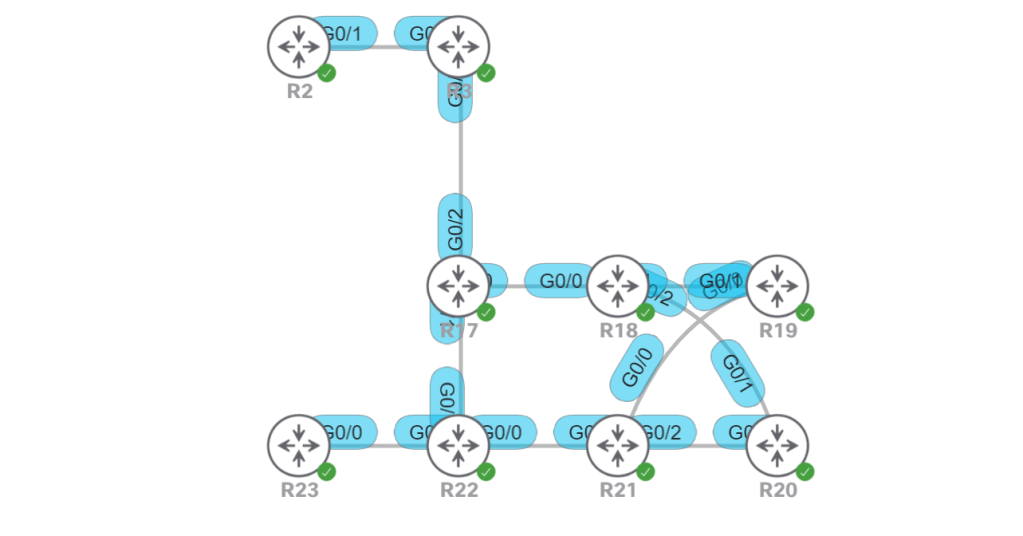
Let’s set up a summary route for the following loopbacks on R20.
R20
interface lo104
ip add 10.10.104.1 255.255.255.0
interface lo105
ip add 10.10.105.1 255.255.255.0
interface lo106
ip add 10.10.106.1 255.255.255.0
interface lo107
ip add 10.10.107.1 255.255.255.0
router eigrp 10
network 10.10.104.0 0.0.0.255
network 10.10.105.0 0.0.0.255
network 10.10.106.0 0.0.0.255
network 10.10.107.0 0.0.0.255
Summarization is per interface. So let’s only summarize towards R18 (G0/1) and see what happens.
interface g0/1
ip summary-address eigrp 10 10.10.104.0/22
So now R21 gets the individual routes and R18 only gets the summary. That means the preferred path from R17 will be through R21, since it’s the longer mask of /24. Let’s get things back to a level playing field by also summarizing on G0/0.
interface gig 0/0
ip summary-address eigrp 10 10.10.104.0/22
Now the path from R17 will prefer the shorter metric and take R18. But maybe we want most of the traffic going that way, but we want traffic from R17 to 10.10.105.0 to go the longer way through R21. For that we can use a leak-map.
access-list 5 permit 10.10.105.0 0.0.0.255
route-map LEAKMAP
match ip address 5
interface gig 0/0
ip summary-address eigrp 10 10.10.104.0/22 leak-map LEAKMAP
We can verify it with a show ip route from R21.

And on R17, we prove that even though the path through R22 has a higher metric, it doesn’t matter because it is a more precise route. Metrics only count when the routes are exactly the same.

 Oscorp Labs